
How to review a city? Should I review cities? I’m toying with the idea and this is my first attempt. I really don’t want to be negative about any place since it’s all going to be so subjective, so I’m trying to come up with a specific set of categories to try and make it a little more objective, but also to highlight why my overall experience may be a “me” problem, and not something everyone visiting would feel or experience. Here are my categories.
- Walkability
- Public Transport / Ride Share
- Attractions
- Groceries
- Restaurants
- Affordability
- Social Dance
- Communication
- Parks
- Weather
- Church
The following is based on my experience in Chiang Mai. Since this is my experience, it’s biased by decisions that I made.
Walkability
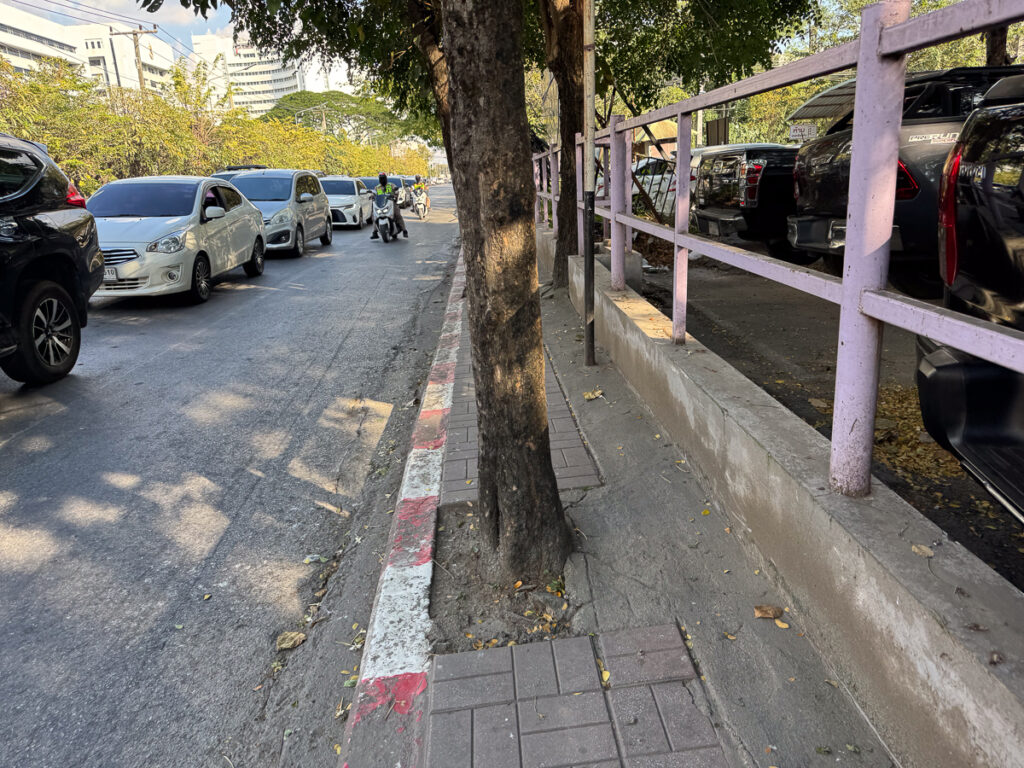
Chiang Mai is just not very walkable. I suspect that it shares this with much of southeast Asia, and it’s quite unfortunate. There aren’t a lot of cross walks. And a lot of the ones that you see don’t have signals of any kind so you just kind of have to get out there.
I will say that drivers here are observant and generally not hostile to pedestrians. So if you start walking across the street when traffic is coming at you and you hold out a hand they will usually slow down or stop. That seemed consistently true for cars. But don’t expect the same from scooters. Scooters are small and nimble. They also tend to split the lanes and will just drive around pedestrians instead of stopping for them.
The next problem with walkability is sidewalks. Where we were and most of the places that we wanted to go had some level of sidewalk but they are wildly inconsistent. Sometimes barely wide enough for one person and other times they’d just disappear without warning. Other times sidewalks would just have trees, light poles, electric poles or other obstacles just right there in the middle of them. And not just one or two, but lots of them, every few meters.
The walking situation always gave us pause if our desired destination was going to require crossing a busy street. That part just wasn’t that much fun.
Public Transit / Ride Share
This one was bit of a mixed bag in Chiang Mai. On the one hand, ride share is cheap and plentiful. Thailand doesn’t use Uber or Lyft like in the US. The big ones here are Bolt and Grab. They work pretty much the same for their basic function. The biggest difference is that you can order a ride that’s on a scooter if you’re bold enough to ride on the back. I was not.
We were told that Bolt would usually be cheaper than Grab, and that did seem true. But both were so much less pricy than than getting an Uber in the US that it was kind of negligible. Thing to be aware of with ride share here is that drivers will accept your hail and take you to places outside of town, but once you’re there you may not be able to get another one to bring you back. I heard lots of stories of tourists getting stuck at gardens and attractions out of town only to be surprised that they can’t get a Grab/Bolt to come and get them once they want to return to town.
The solution is to hire a driver for a round trip. Fortunately, or unfortunately, we never ended up doing this because by the time we learned how it worked, we’d met an expat who was on a roll with setting up group rides to spend the day enjoying near by activities. We just went with her whenever there were enough people interested. It worked great and was dirt cheap. Like 300-600 bhat for a day trip. ($10~$20).
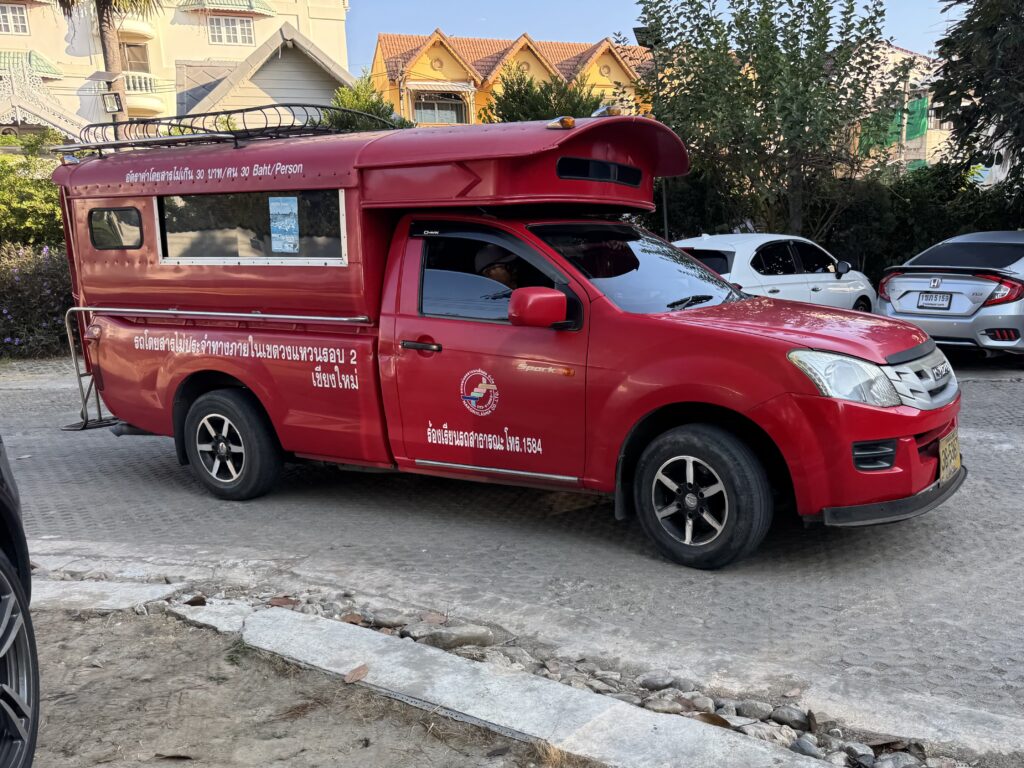
I’m not very knowledgeable about the details of how this system works but in lieu of a proper bus system (which I’m told Chiang Mai has though I never saw one) what they have instead as a system of Red, Blue and Yellow trucks called Songthaews. The Red ones are the most common and you’ll see them all around the city. It’s basically a pickup truck with a covered back and two bench seats running parallel to the sides. Riders sit in them facing each other with eight people fitting comfortably. In theory for about 30 bhat per person you can go anywhere within the city. You can also hire the drivers to do a round trip. They’ll take you to an activity and wait for you for a predetermined amount of time. The cost for something like that is up for negotiation. Red is mostly for near old town, the other colors are for farther journeys. But if you hire one for the day, they’ll go wherever you want. We took them for a couple of nearly two-hour one way trips to visit waterfalls.
There area also plenty of private drivers with cars or vans that you can hire. Those cost a lot more, but are obviously more comfortable and have climate control. Those are better suited if where you’re looking to go is a long way from town. You can find drivers on various facebook groups, or you can use a service like DayTrip.com.
Oh, and of course this being Thailand, Chiang Mai also has Tuk Tuk’s. A Tuk Tuk is basically a motorcycle with a passenger carriage welded onto it. The steering and controls look like a motorcycle but the back has two wheels and usually enough space for two to sit comfortably, though I’ve seen 4 or more piled in.
I noticed that Tuk Tuk’s in Chiang Mai were smaller than the ones in Bangkok which typically had seating for 4 instead of two. Not sure why, but that’s how it appeared to be.
With all of these options, you’d think that I’d be pleased with transit, but not having regular buses with a consistent schedule always made getting somewhere feel like a bit like a crap shoot. Maybe you’d get a ride and get to your destination quickly, maybe they’d have you wait for 20 minutes and then just cancel the fare. That said, grabbing a Tuk Tuk seemed to be the easiest and most consistent thing to travel *if* you were in a place where they hang out. Pretty much everywhere in the old town near Maya mall was very easy. We were living in a more residential area so we never saw Tuk Tuk’s or red trucks that you could just wave down unless we went a few blocks away. But they were usually easy to hail for going home if we were at some popular location. One other observation. Bolt and Grab were always cheaper than Tuk Tuks. Coming home from the old town, a Tuk Tuk would usually cost between 200-300 bhat. Getting there via grab was always less than 200.
Attractions
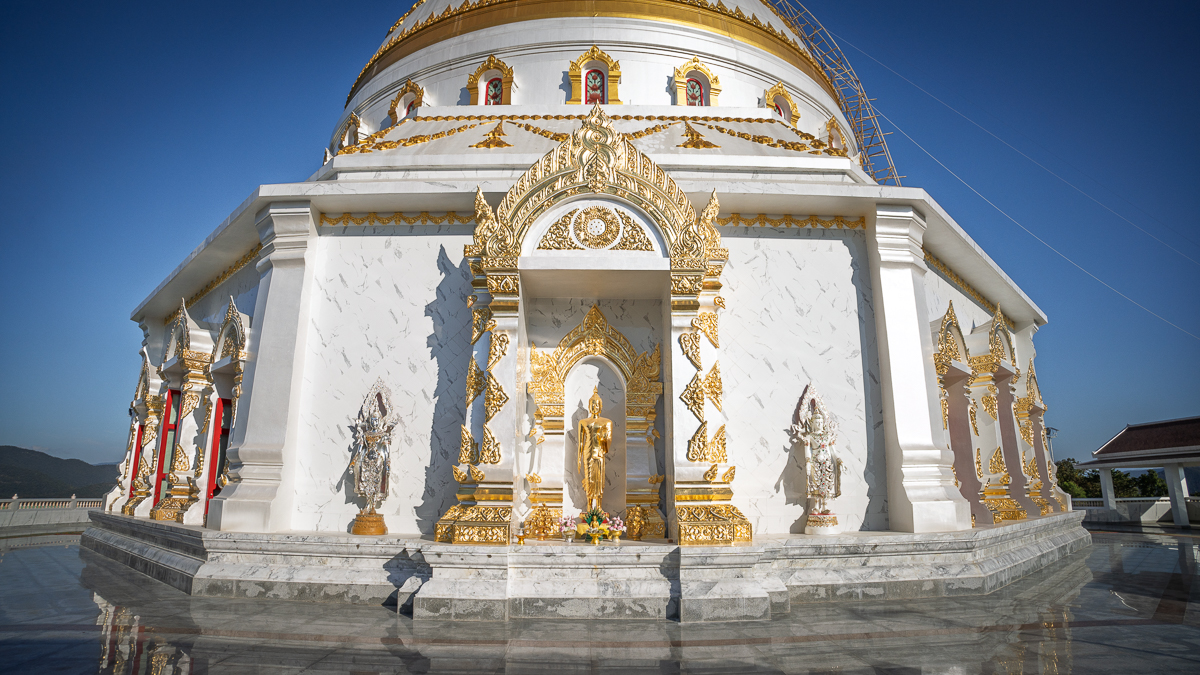
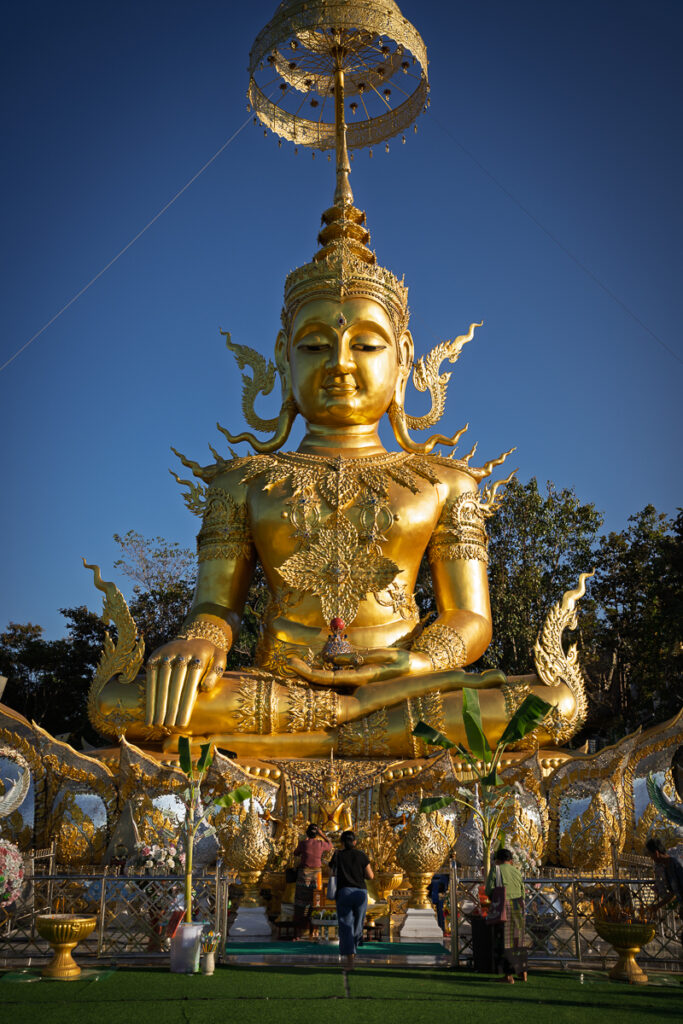
There are a lot of beautiful natural places near Chiang Mai but the most unique thing to the region has to be the temples. There are so many. Big and small. In town, out in the mountains, they are absolutely everywhere. They are always extremely ornate and usually have a breathtaking Buddha statue inside.
Groceries
Ok, we rent furnished apartments because we like to be able to cook for ourselves most of the time. This is generally pointless in Thailand. Food is so good and so cheap and so prevalent it’s hardly worth the trouble to cook for yourself. Grab has an Uber Eats like feature where scooters will pickup whatever you want from wherever you want it and they almost always got it to us faster than they said they would.
That said, in our first few days in Chiang Mai we wanted to stock our kitchen with a few basics, some breakfast foods and to try out a couple of recipes.
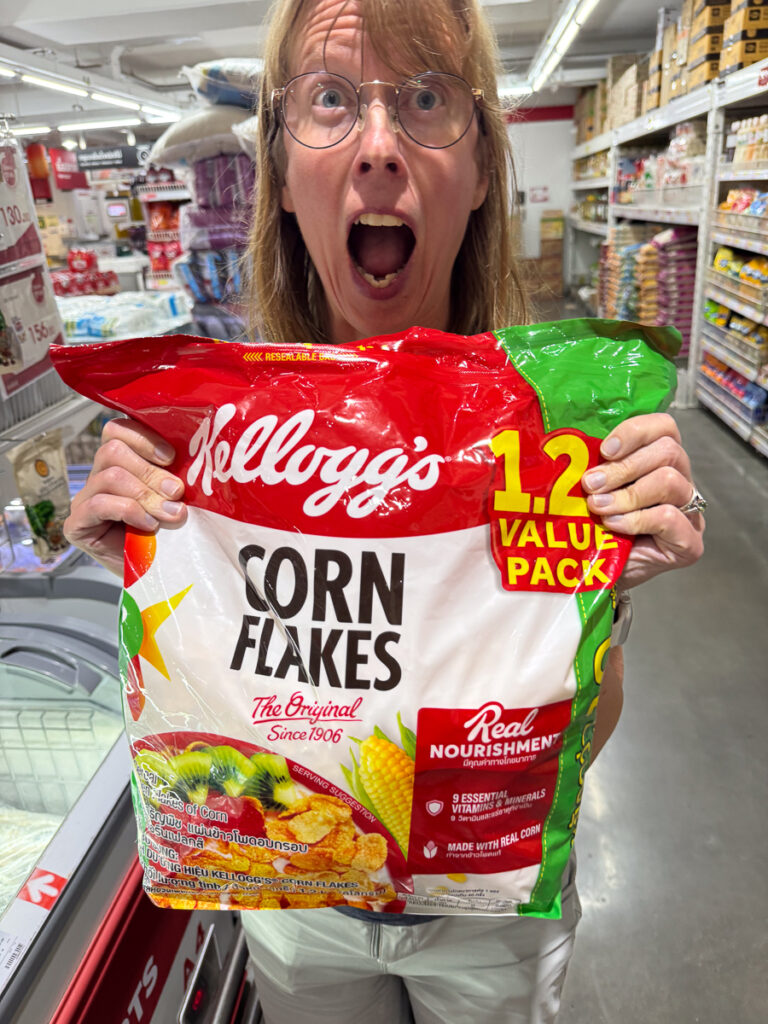
We found that the Tops grocery store near us was really more of a convenience store than a full on grocery store, however they did have ground (non-instant) coffee, which none of the 7Eleven’s seemed to stock. They had some veggies and raw meats but not a wide variety of them. They had some fruit, but again not a lot of variety. Later we realize two things. One, just a little further down the road was a much larger and more fully stocked grocery store. But also that the open air market the other direction from us had all the fruit, nuts and vegetables that you could imagine. They had great mangos and watermelon. I think that they also have a wet market for getting meat but I think that it only operates sometimes. Generally you want to go to these places in the morning. But we were too lazy to bother.
Restaurants
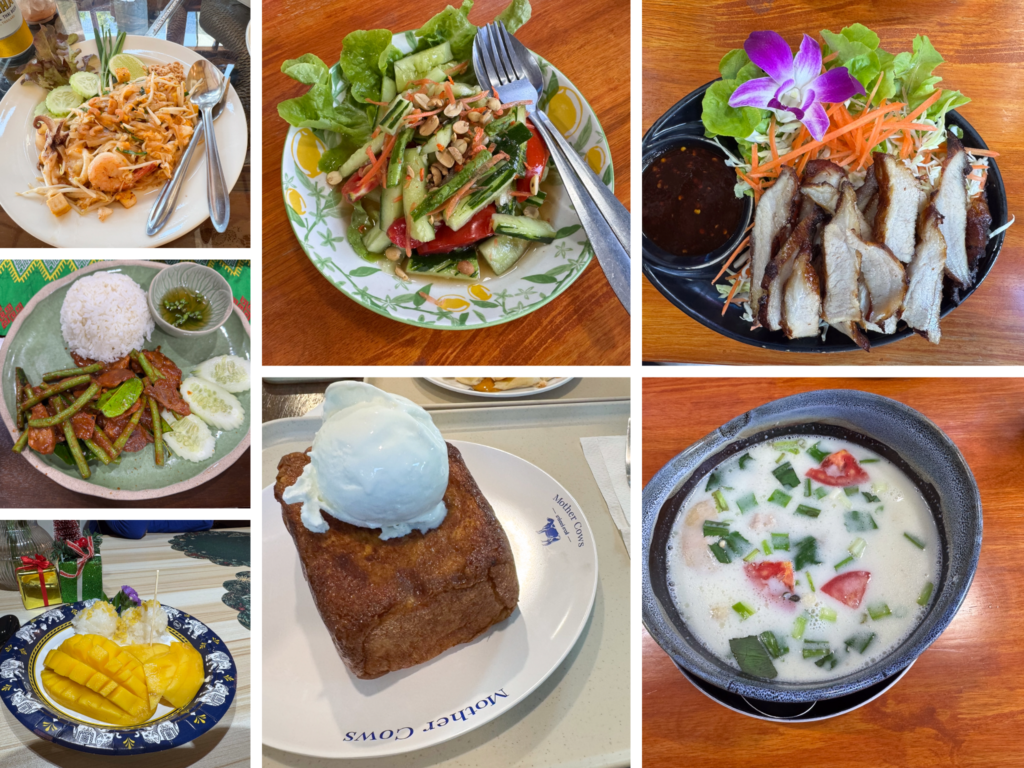
Plentiful. So, so many choices. Everything from Thai classics like Pad Kra Pow and Pad See Eu to regional specialties like Khao Soi and western fast food like Taco Bell and McDonalds. Everything is just a few taps away on your phone. If you step outside and start walking any direction you’ll quickly find various meats on sticks, plastic bags of soups and curries from small vendors. The biggest surprise to me was how much fried chicken there was. I didn’t realize it was such a big thing here. Most 7-Elevens would have a 5 Star Chicken in the parking lot or somewhere nearby.
In my opinion, if you like spicy food at all. Just get it Thai hot. If you hem and haw they’ll leave out the chillies giving you a boring bland mess. YMMV.
Our least interesting meal was probably the most expensive one. It was a fancy-ish Thai place near One Nimman. Their mango sticky rice was the least flavorful. Just take that warning and don’t skip the small shops. Look at where the locals go, and do that.
Affordability
Our apartment in Chiang Mai was about 1/3 of the cost of the place we rented in Seville, Spain, a few months earlier. And we are in peak season, and rented this place for a week longer.
A meal from a restaurant with 3-4 entries (enough food for 2+ people) will easily cost you less than 1000 bhat (30 dollars). And that could include a beer or two.
The only thing in Thailand that seems pricy is alcohol. Bottles of wine and spirits cost about what they do in the US. A moderately priced bottle of will probably cost $25+ and a bottle of whiskey or Gin would probably be similar in price.
Social Dance
We didn’t dance much here but we did go out to a Swing Dance and to a Salsa, Bachata, Kizomba dance. I saw more dances going on during our time here but we were busy doing other things. Many of the dancers that we interacted with were other travelers or expats. We didn’t see a lot of locals. Not sure if that’s because of us being here around the holidays, or if that’s just how it is here.
Communication
There is so much English spoken here. It’s very different than what we experienced in Japan and China where it seems that almost no one speaks English so we would usually rely on translation apps to speak to people. But here in Thailand, especially Chiang Mai, I just go in assuming a basic proficiency with English and if we speak slowly and listen carefully it was usually easy enough to communicate and perform basic transactions like ordering food, or getting a ride (gestures and google maps go a long way).
Parks
I was pretty disheartened by the lack of nice, natural outdoor space to walk and hang out in. In my experience, they are few and far between in Chiang Mai.
There are national parks in the region, and multiple gardens in the metro area but those aren’t places that you will easily visit without transportation. What I really missed were accessible neighborhood parks.
Weather
Just about perfect. We were strategic here and aimed to visit Chiang Mai at its most comfortable and I’d say that we nailed it. During our month there the weather was usually mid 60’s at night and mid 80’s in the day time. In four weeks, I think that it might have rained once. Otherwise it was just blue skies and sunshine.
Church
Christian churches are few and far between here, which makes sense with the population being 90% buddhist. Chrissy did manage to find a Lutheran church here which has been having worship for a number of years now. We managed to attend service with them a couple of times and could kind of follow along even though everything was in Thai. There were larger Christian churches of other denominations (Catholic, maybe Baptist) that we saw, but didn’t put much research into those.
Will you come back?
Probably? It’s certainly a cost effective place to spend the winter months. The weather is great, the food is fantastic, the people are nice and everywhere you go no matter what time of day or night feels safe.
The biggest downsides to Chiang Mai are the challenges with being a pedestrian, and the lack of parks.
The real question at this point would likely come down to visiting somewhere we’ve already been, or trying out a new city. The world is big, and every city… every neighborhood has something different to offer.


